Creating the Single Market and the euro
What is in our Archives?
Our archivists' selection on the Single Market and the euro

The 1962 Van Campen Report
In 1962, the European Parliament showed a heightened interest in the monetary aspect of the European Economic Community (EEC). The Economic and Monetary Committee of the European Parliament, led by rapporteur Philippus van Campen, produced the first report on the coordination of monetary policies:
"However, the experience of the early years has already shown that the creation of a customs union is closely linked to the achievement of an economic union. The fact that, since moving from the first to the second stage, the EEC countries have been required to pursue a common economic policy in certain sectors clearly demonstrates this. That is why it is inconceivable that the coordination of the Member States’ monetary policies could be postponed until the completion of the economic union. "

Report on the revival of Economic and Monetary Union
An economic and monetary union (EMU) was a recurring ambition for the European Economic Community from the late 1960s onwards. With an Assembly still composed by non-directly elected MEPs and as a response of a motion of a resolution tabled by several MEPs, the Economic and Monetary Affairs Committee appointed Lord Ardwick for this report in which he defends the idea that a common market could not be achieved “in one giant stride” but should be done in several stages.
"Some people use the term “Economic and Monetary Union” loosely. They mean by it any sustantial mesure of economic and monetary integration. In this report, the term EMU will be used strictly to mean a union in which a single currency replaces the currencies of Member States and is supported by the necessary economic and financial policies
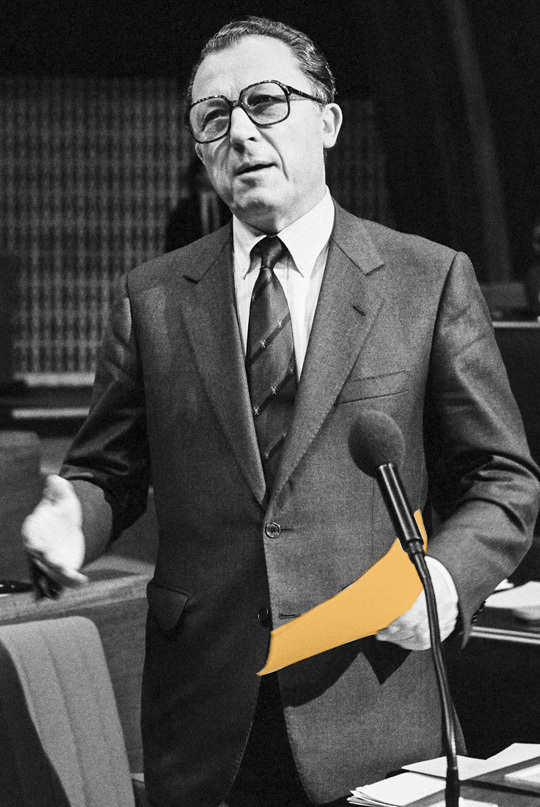
Report on economic and monetary union in the European Community
Commissioned by the European Council, the committee chaired by Jacques Delors outlined a plan to complete the single market, coordinate economic policies, and ultimately establish a single currency in three stages. Submitted in April 1989, the report served as the foundation for the creation of the single currency and the European Monetary Institute, the forerunner of the European Central Bank.
"The process of integration based on a step-by-step approach requires, however, a clear understanding of its content and final objective, its basic functional and institutional arrangements and the provisions governing its gradual implementation. A new political and legal basis would accordingly be needed.”
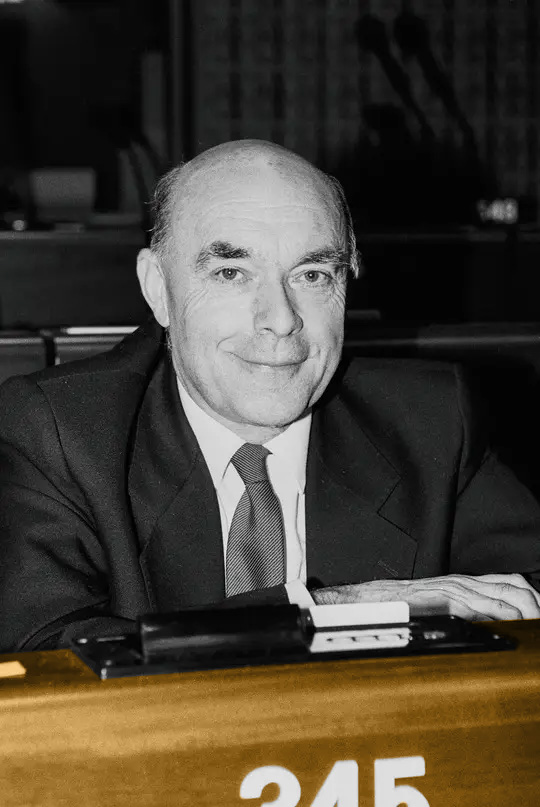
Interim Report drawn up on Economic and Monetary Union
In April 1990, the Committee on Economic and Monetary Affairs presented an interim motion for a resolution on the Single Market, led by rapporteur Fernand Herman. The key points included the urgency of establishing a political union to integrate a unified Germany and Eastern countries, the need for a stronger role for the European Parliament, the implementation of a single currency, and enhancing the autonomy of the European central banking system.
"(...) whereas, in a democratically ordered society, the above independence must be counterbalanced by being made subject to public accountability and whereas the leaders of the European central bank system must consequently be called to give account of their stewardship before the European Parliament”

Report on Economic and Monetary Union
Following its interim report submitted in April 1990, the Committee of Economic and Monetary Affairs, with Fernand Herman as rapporteur presented — one month later — this document which portraits the European Parliament functioning of the economic and monetary union and the launching of the Single Market, including the creation, role and powers of the European Central Bank.
This report was a political attempt to ensure Parliament had a voice in shaping what would become the Treaty on European Union (the 1992 Maastricht Treaty) which created the European Union.
"Monetary Union shall imply the circulation of a single currency, the conduct of a single external and internal Monetary policy and the establishment of a European system of central banks, including the autonomous European Central Bank.

Report: Lessons to be drawn for the implementation of the EMU
The concept of "trinity" in global economics states that a country can only choose two out of three options: fixed exchange rates, free capital movements, and independent national policies. In 1993, the Committee of Economic and Monetary Affairs and Industrial Policy reviewed four potential reforms for the European Monetary Union. João Cravinho, the rapporteur, highlighted the advantages of the European Parliament's proposal to empower the European Monetary Institute (EMI), as it helped address the issues of the inconsistent "trinity":
"The fourth option is of the rapporteur, which builds on previous resolutions of Parliament. It can be summarized 'allow the European Monetary Institute (EMI) to fully develop its primary and secondary tasks conferred upon it by the TEU and thus establish a dual-anchor for the second phase of EMU."

Speech by MEP Karl von Wogau
In 1994, the chairman of the Committee on Economic and Monetary Affairs and Industrial Policy of the European Parliament, Karl von Wogau, described the European Parliament’s view in deepening and widening the monetary and political union before the conference on 'The Transition to the Monetary Union' :
"(...) It is too early to say what precise proposals the European Parliament will submit. But a few points are not unrealistic:
Its role in decision-making on the European level in the political and economic union must be enhanced;
progress in achieving political and economic union must be made;
a new treaty must ensure that the European Union will be able to function efficiently with more than 15 or 16 members.

Report on the Euro on the consumer
In September 1997, before the euro's introduction for financial transactions in January 1999, the European Parliament's Committee on Economic and Monetary Affairs (ECON) requested a report to study the impact of the three-year transition period on consumers. The report, with Fernando Pérez Royo serving as rapporteur, was released in December 1997.
"It is very important that people get used to "thinking" in euros. Therefore dual pricing should be used as soon as possible in order for consumers to start getting the value scale right, not only for products and services, but also for salary statements and documents from public authorities mentioning a sum of money. "
⠀
⠀

Introduction of the single currency
On 17 April 1998, the European Parliament welcomed the implementation of the Euro in several member states and approved the start of the third stage of the Economic and Monetary Union on 1 January 1999, as well as the foundation "as soon as possible" of the European Central Bank;
"The European Parliament, (...) welcomes the introduction of the single currency by 11 Member States which have fulfilled the requisite conditions and should like to enter the third stage of EMU on 1 January 1999, namely Austria, Belgium, Finland, France, Germany, Ireland, Italy, Luxembourg, the Netherlands, Portugal and Spain."
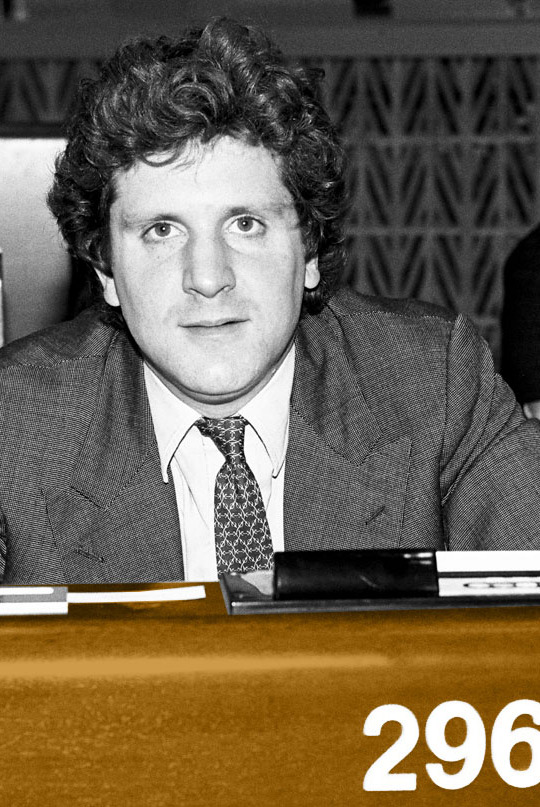
Report on Euro as a parallel currency
In November 1998, as the third stage of the Economic and Monetary Union approached, the Committee on Economic and Monetary Affairs, with John Stevens as Rapporteur, highlighted the issues related to using the Euro as a parallel currency. With four of the fifteen member states not joining the Single Currency, concerns about the volatility of national currencies against the Euro had to be identified.
The Central Banks of the United Kingdom, Sweden, Denmark and Greece should all make official statements, before 1st January 1999, on how they envisage parallel Euro use will develop in their respective economies over the next three years and how they recommend financial institutions, enterprises and consumers should act in these circumstances; these statements to be presented to the European Parliament through the Monetary Affairs Subcommittee